
Supporters of Senate File 59, “K-12 language and literacy program,” look on as Gov. Mark Gordon signs the bill into law Friday in his ceremonial room. The program is designed to ensure all Wyoming students in grades K-12 receive evidence-based reading instruction, along with early screeners, multi-tiered systems of support and interventions and individual reading plans for struggling readers. Carrie Haderlie/Wyoming Tribune Eagle CHEYENNE (WyomingNews.com) — Surrounded by advocates, parents and children, Gov. Mark Gordon signed the state’s new literacy plan into law Friday afternoon. Gordon signed Senate Enrolled Act 43, “K-12 Language and Literacy Program,” which is designed to ensure all Wyoming students receive evidence-based reading instruction, along with early screeners, multi-tiered systems of support and interventions and individual reading plans for struggling readers. State Superintendent of Public Instruction Megan Degenfelder said the day was “tremendously exciting” and the culmination of an effort years in the making. “I am proud to say we got the job done, and it was because of so many people that were part of the process,” she said. “Today, the signal is that Wyoming is not going to let a single child fall through the cracks.” Rep. Landon Brown, R-Cheyenne, said the bill being passed, applying to all students K-12, means that every student matters. “We owe it to them, we owe it to their families, we owe it to every single taxpayer that has been paying for our education system. We owe it to them that they can read when they leave high school,” Brown said. Currently, reading, screening and intervention programs require school districts to implement literacy programs for students in kindergarten through third grade, Gordon said. “This act repeals existing law, creating the Wyoming language and literacy program … that requires districts to implement literacy plans that serve students in kindergarten through grade 12,” Gordon said. Literacy plans must identify students with reading difficulties, use universal and dyslexia screeners, diagnostic assessments and deliver evidence-based language and literacy instruction.The act also requires districts with 60% or more students reading below grade level proficiency to offer summer literacy camps or extended support programs. The act also requires the Wyoming Department of Education to establish a literacy division to administer the program, as well as to identify universal and dyslexia assessments, evidence-based instruction and instructional materials in state rules. This act also requires the department to establish professional development requirements related to literacy instruction. Before the bill signing, Annie McGlothlin, co-founder of WYO Right to Read, said the law represents a win for families and children, particularly those who struggle with dyslexia. “We are all looking at this cautiously optimistic to make sure that the bill, as it is written, is actually implemented, not only the evidence-based programs that are necessary, but equally important is the teacher training,” she said. “If the bill is implemented as is intended, then families who have children with dyslexia have a little more leverage. There is federal law, but this adds an extra layer of protection for families.” The process had been stressful for many families, but they persevered, she said. “They persevered, because we love our kids,” McGlothlin said. Chandel Pine, founded Paul’s Mountain-Advocacy for Literacy in memory of her son, Paul, who died by suicide at Carpenter Elementary School in 2023. Pine established her nonprofit to help children who struggle to read. “I didn’t think this was going to happen, with it being a budget year. But when the LSO number was Paul’s birthday, I was like, maybe God has this in his path,” Pine told the WTE. “He wants us to climb Paul’s mountain. I’m grateful that all the legislators listened to what the children need. This is for the kids, and adults need to do what is best for them.” Surrounded by children, Gordon said the act will go into effect July 1. “What are we going to do before then?” Gordon asked. “Read!” several children replied. Governor signs literacy bill into law as advocates celebrate perseverance Carrie Haderlie Wyoming Tribune Eagle | Mar 6, 2026 Updated Mar 10, 2026 | News | wyomingnews.com

Article updated March 10, 2026 Recently, while reviewing our property tax statement, I noticed what we all know: a significant portion of our taxes fund education. This is exactly as it should be. We should wholeheartedly support quality education and equal access to that education for all Wyoming children. But here’s the question that keeps me up at night: Why do we continue paying property taxes for education when one in five of our children — those with dyslexia — are systematically denied the opportunity to learn to read? This is not how our tax dollars are supposed to work. Currently in Wyoming, dyslexic children receive evidence-based reading instruction if their parents can afford private tutoring or have the resources to hire special education attorneys. Let that sink in. We’re talking about approximately 18,897 students out of Wyoming’s 94,488 total enrollment — 20% of our student population whose right to literacy depends on their family’s income. Of these nearly 19,000 students, approximately 11,338 fall within the mild-to-moderate range of dyslexia, while approximately 7,558 struggle with more severe or profound forms requiring intense, long-term support. These aren’t small numbers. These are thousands of Wyoming children being left behind. This isn’t about local control — it’s about accountability Some argue this is a “local control” issue. We at WYO Right to Read disagree. This is about school districts doing what they’re paid to do: teach our children to read. When we hand over our tax dollars, we have every right to expect results. The science is clear. Reading instruction isn’t rocket science — but it does require proper training. A one- or three-day workshop doesn’t cut it. Professional development dollars must show results, and currently, they don’t. Our special education teachers want to help. Most are eager to learn evidence-based methods that work. They need — and deserve — comprehensive training in programs approved by the International Dyslexia Association, delivered by experts who understand the neuroscience of reading. These dedicated educators shouldn’t be set up to fail, and our children shouldn’t pay the price for inadequate district support. The science of reading isn’t new Those of us over 40 remember learning to read through systematic phonics instruction. We were taught phonemic awareness first. Guessing strategies, contextual cues and picture prompts were never considered legitimate teaching methods — because they aren’t. Decades of research confirm what we knew then: explicit, systematic instruction in phonics works for ALL students, because it does not rely on children figuring out the written code of spoken language on their own. The three-cueing method and balanced literacy approaches have been debunked repeatedly by scientific studies. Yet many Wyoming classrooms still rely on these disproven methods, leaving struggling readers farther behind each year. Just like some children need more explicit instruction and practice learning to swim or to throw a football, some children need more explicit instruction and practice learning the written code of spoken language which structured literacy provides. What about parents’ rights? Parents have a right to expect more from our school districts. No parent should come home to find their child having an emotional breakdown because their teacher wasn’t trained in methods that actually work. We want our children to feel confident and capable in school — not humiliated, isolated or depressed. What’s happening to dyslexic students in Wyoming is beyond the pale. These are bright children. They can learn to read beautifully when taught with structured literacy approaches. Denying them this instruction is unthinkable, and we need to start talking about it that way. A path forward The Wyoming Joint Education Committee passed a K-12 Language and Literacy bill that will finally provide accountability. This upcoming legislation will be introduced in the Senate. The bill will ensure that all students receive structured literacy instruction grounded in the science of reading. It will hold school districts accountable to Wyoming Chapter 56 rules and federal requirements guaranteeing equal access to quality education. This bill isn’t asking for anything radical. It simply requires that evidence-based methods — the kind approved by the International Dyslexia Association and supported by decades of research — be used to teach all children to read. Call your legislator and tell them to vote YES on the JEC K-12 Language & Literacy bill. The bottom line Reading is a right, not a privilege reserved for children whose parents can afford private intervention. When we pay our property taxes, we’re investing in the future of our state. We have every right to demand that school districts use proven methods, train teachers properly, and ensure every Wyoming child learns to read.
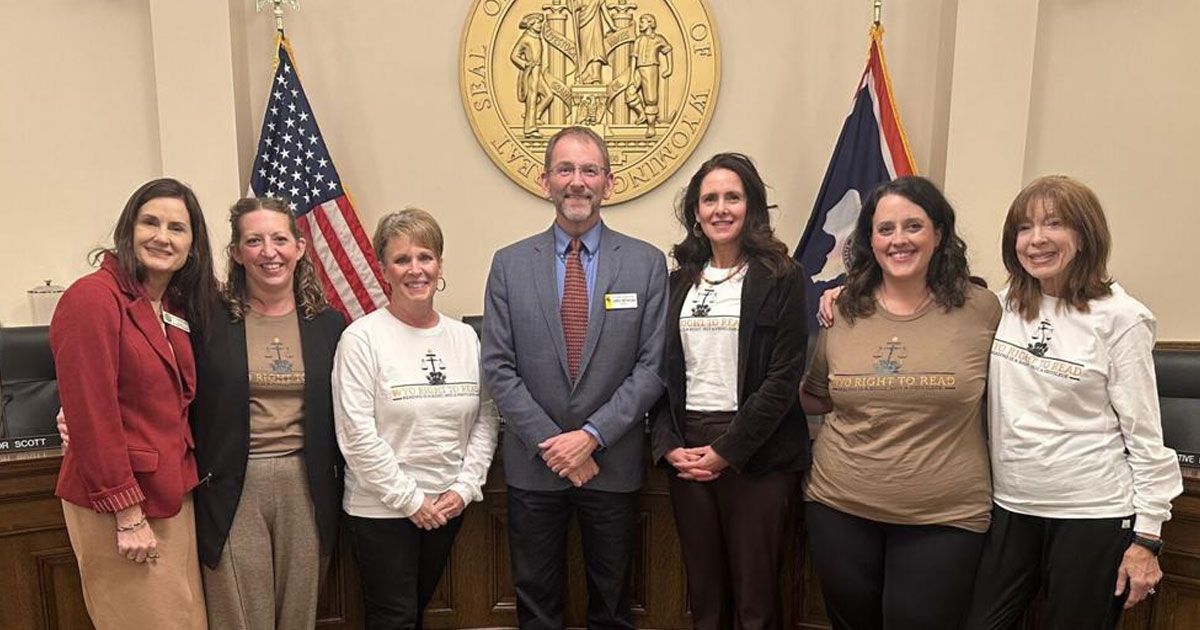
WYO Right to Read advocates pose with state Sen. Chris Rothfuss, D-Laramie. Courtesy of WYO Right to Read CHEYENNE — Dyslexia advocates pushing for new legislation to address reading intervention in the state may face an uphill battle getting a bill unrelated to the budget passed during the upcoming session. Though the bill ultimately received support from lawmakers during a Joint Education Committee meeting earlier this month, there is still a lot of advocacy needed to get the bill passed. If passed, the bill would establish a more robust K-12 language and literacy program. "The biggest thing is we've just got to make sure that our fellow legislators understand that in their own districts we're leaving kids behind," co-Chair Sen. Wendy Schuler, R-Evanston, told the Wyoming Tribune Eagle. Not only will advocates face the typical struggles of getting a non-budget bill introduced — which requires a two-thirds majority in a bill's chamber of origin — and passed during a budget session, a handful of legislators have expressed concerns about government overreach and the extent to which the bill governs the way reading is taught. Wyoming already has literacy-related laws on the books; however, advocates with local nonprofit WYO Right to Read say that those laws are not being enforced, and children are being left behind. Unlike existing laws, this new bill is focused on more up-to-date methods supported by the science of reading, a comprehensive body of research that explains how the brain learns to read and write. "Our goal is to go and meet with every legislator," Gay Wilson with WYO Right to Read said. "It's not just us, it's other stakeholders in the state that want to help educate legislators, principals and teachers on evidence-based instruction and the science of reading. Because … they don't know what they don't know." As it is currently written, the bill would prohibit the use of three queuing systems as a basis for teaching word recognition, and outlines requirements for how all Wyoming students, particularly those with dyslexia or other reading difficulties, would receive "structured, evidence-based literacy instruction," according to WYO Right to Read. "Every time you turn around, there's a principal, there's this teacher, a special ed teacher and administrators saying, 'Well, I'm sorry, the state of Wyoming doesn't recognize dyslexia,'" Annie McGlothlin with WYO Right to Read said. Though Wyoming legally does recognize dyslexia, McGlothlin said misinformation in school districts has led to several parents being told that is not the case. "When that misinformation is being disseminated across our state … what does that say about children's rights to read?" McGlothlin said. While the state ranks competitively in academic testing, literacy issues are still prevalent, particularly in test scores. In 2024, fewer Wyoming students performed at or above proficiency levels than in the previous five years. In 2024, NAEP testing showed 36% of the state's fourth graders and 29% of eighth graders performed at or above the proficient level in reading. Earlier this month, several parents, advocates and children told the committee, sometimes through tears, about the struggles that kids not meeting proficiency standards face. Chandel Pine, an advocate with WYO Right to Read, was among those parents. Her son, Paul, faced mental health problems that stemmed from reading difficulties, even after being held back in kindergarten and receiving interventions each year. He died by suicide in fifth grade. "He never got that instruction in school because he was supposed to on the first day of his Individualized Education Plan (IEP) when he hung himself," Pine said. Pine noted that most parents whose children face reading difficulties aren't aware of the terminology around reading. They don't know what the science of reading is, or how some methods of teaching reading are more evidence-based than others. All she knew when Paul died was that she trusted the public school system to teach her son to read. "After years of failed interventions that impacted my son's mental health — he thought he was stupid, that he didn't deserve many things, he just beat himself up because he didn't know how to read — why did we have to wait until that point?" Pine said. For parents like Pine, who are aware of the science of reading and recommended methods, this bill serves as a way to catch the kids who are being left behind. Rep. Tom Kelly, R-Sheridan, was among those critical of the bill. He noted that while it is clear the state has a problem, he worried about "a sweeping one-size-fits-all policy for all districts," regardless of need. "I do have concerns that if there are districts that currently have in place systems that are working that this could possibly disrupt those systems that are working," Kelly said during the committee meeting. Kelly's concerns were shared by Wyoming Association of School Administrators Executive Director Boyd Brown. "I'm not aware of any other place in statute where a teacher was told they could not use an instructional tool to help improve a student," Brown said, referring to the bill's prohibition of the three queuing system. "... I think teachers need to have as many arrows in their quiver as students need to be successful." WYO Right to Read advocates rejected the idea that this would disrupt working programs, because those programs don't work for kids with dyslexia. Rather they said that these methods are proven to work for every child, without leaving kids with learning disabilities behind. "Every child learns to read the same way," Kari Roden with WYO Right to Read said, referring to the science of reading. "For some, it's easier, and for some, it's harder. You just have to give more intense instruction to the kids where it's harder; that's it." Like many of the women with WYO Right to Read, Roden has been advocating to the Legislature on this topic for years. She is a Wilson Dyslexia Therapist and a CERI-certified Structured Literacy Dyslexia Specialist, who also serves on the International Dyslexia Association Rocky Mountain Branch Board of Directors. Though the concern about overreach was well discussed at the meeting, Schuler said the bill has been such a collaborative effort that hopefully this time they got it right to help Wyoming kids. "We've got to think outside of our own little community and our own school and our own families, and say, 'Are we doing the best we can to make the best laws we can to help everybody,'" Schuler said. She added that she, like her peers, wants to see every child be successful and happy and to love Wyoming like she does. "If it's an overreach, I think it's an overreach for the right reasons," Schuler said. GullPrint 12/17/25, 10:30 AM Literacy advocates aim to educate legislators on science of reading | News | wyomingnews.com
Legislation would create a framework for more rigorous assessment, teacher training and tailored strategies to help Wyoming's struggling readers. 'Please do not fail these children,' one grandfather said. by Katie Klingsporn Many tears were shed inside a nondescript meeting room inside the Wyoming Capitol, where legislators gathered last week to discuss education policy. Adolescent students cried while telling lawmakers about their own debilitating reading struggles and the subsequent anxiety and self-doubt they felt. Parents broke down describing the frustrations of watching their children advance in grades even as their reading difficulties undeniably impacted their performance. A grandfather's voice cracked as he recounted the transformation his granddaughter made once she was finally identified as dyslexic and received appropriate help. "Please do not fail these children," the grandfather, John Ridley, implored lawmakers on the Legislature's Joint Education Committee. Ridley joined family members, students and educators calling for the committee to advance draft legislation that would create a more robust K-12 language and literacy program in Wyoming . Over several hours Wednesday, the literacy advocates described in detail their own personal challenges with reading instruction in Wyoming schools. Parents talked about recognizing deep learning challenges in their children that educators assured them were no big deal. Educators spoke about how a popular method for teaching reading has been debunked in recent years and should be outlawed for the way it leaves certain students behind. And students spoke of a growing dread and anxiety around their inability to keep up in school. Many of them talked about Paul Pine, the Cheyenne fifth grader whose story has become emblematic of how deeply literacy struggles can impact lives. Despite repeating kindergarten and receiving small-group interventions, Pine was only reading at a first-grade level by fifth grade. It wasn't until that year that assessments determined he was likely dyslexic. By then he was distraught, and he died by suicide one day in 2023.

The struggle to teach him to tie his shoes was immense, so we hit pause until he was a little older then, a little older. I didn't know. The next year, he went to the nurse nearly every day with an upset stomach at math time, which followed writing. I didn't know. (Literally that one I didn't know because the school didn't tell me until the end of the year.) All the things I didn't know pointed to a problem, but his classroom teachers didn't know, either. When it was starting to be recognized that he was struggling in first grade, the only advice given by his teacher was to make him read more at home. They didn't know, I didn't know, but I soon found out that was not the answer. In the middle of first grade, a friend said the word dyslexia — it wasn't on my radar. I didn't know. It wasn't just a light bulb moment; it was a military-grade search light aimed right at my family. This was the start of my knowing, because it didn't take very long with my friend Google to be 99% sure this was the problem. By this time, I was worried, my husband was worried, and little sister was feeling it as she watched us have to devote more time to her brother to figure out what to do next and how to help him. The school tried their best, but they didn't know, and they didn't spend any time with Google, falling down a rabbit hole. I did. The rabbit hole led to a mom with a degree in fine art getting a master's in education. I can tell you, even though I know, the rabbit hole hasn't ended (or maybe it has, and I'm just stuck in an alternate Wonderland filled with IEP meetings, fighting the schools for appropriate services, tears, anxiety, school trauma and now homeschool). Ironically, some of those IEP meetings could have been mistaken for the Hatter's tea party in Wonderland, the nonsense said was sometimes wild. They didn't know. Megan Hesser is the director of WYO Right to Read and owner of Hesser Literacy Partners, LLC. Despite dyslexia being the most common learning disability a teacher will see in their classroom, most don't know because teacher's prep has largely avoided teaching them about it, and most of the professional development they get on the job avoids it or uses questionable sources. They don't know. Enough is enough. We must support our teachers better because they need to know and they need to be able to help their students. They need to know that telling parents of struggling readers to make them read more at home, or that one day they will mature and it will just click, are fallacies. Human brains must be taught explicitly how to read; we are not hard wired for that skill. In fact, we must rewire and use parts of our brain intended for other things to be able to learn to read. For some, that is a biologically greater struggle than for others. Reading happens on a continuum of "excellent" to "unable," with every shade of skill level in between. The other irony parents in the dyslexia world face is that what can teach our children to read works for all students, but it is the only way for our kids, and they rarely get it in public school; it's why only 36% of fourth graders are reading at grade level in Wyoming (NAEP, 2024). There are districts prioritizing teaching their teachers what they need to know, providing the tools, and supports necessary to reach all their students. Locally, it's been a slow, uphill battle, largely because our administrators came from those same teacher's prep programs. They don't know what they don't know, so they aren't always making the best selections to drive the change needed for our kids. What our kids need now is for parents, teachers and administrators to come together with the Wyoming Department of Education and ask our legislators to do the right thing for Wyoming students and teachers. It's time to pass a comprehensive language and literacy act that can fill the cracks in public education that are swallowing our kids whole and propel ALL our students to a better future. It's time to stop saying. "I didn't know." Megan Hesser is the director of WYO Right to Read and owner of Hesser Literacy Partners, LLC. 11/7/25, 9:55 AM Hesser: To help students with dyslexia, we all need to know more | Guest Column | wyomingnews.com

I am not an attorney, and I do not give legal advice. I am a grandmother — one who found herself thrust into special-education law after watching my bright, creative grandson struggle to read. He has dyslexia. Like so many Wyoming children, he was failing in school — not because he wasn't smart, but because the system didn't know how to teach him. Because our youngest son has autism — he's now nearly 40 — we learned about special-education law long ago. Back then, he wasn't learning through traditional instruction, either. After research, we discovered that Applied Behavior Analysis (ABA) was the evidence-based method he needed. We hired an attorney, pursued that right and prevailed. That experience taught us something lasting: when a specific method is essential to a child's progress, the law supports parents who insist upon it. Today, I find myself fighting a similar battle — but this time for my grandson. After years of advocacy, he continues to receive the evidence-based instruction he needs to learn to read. Annie McGlothlin, co-founder of WYO Right to Read, has spent decades advocating for children's educational rights and for the rights of adults with disabilities to live with choice, dignity, and opportunity. A paralegal, mother of an adult son with autism, and grandmother raising a grandson with dyslexia, she was instrumental in passing 2019 legislation to protect children in the court system and organized the 2014 Capitol march for disability funding. For more, visit WYORightToRead.org. The legal foundation: IDEA, Section 504 and ADA Under the Individuals with Disabilities Education Act (IDEA), every child with a disability has the right to a Free Appropriate Public Education (FAPE) — one designed to meet their unique needs and prepare them for further education, employment and independent living. Dyslexia is explicitly listed as a "specific learning disability." That means students with dyslexia are entitled to individualized, evidence-based instruction delivered by qualified teachers. Section 504 of the Rehabilitation Act and the Americans with Disabilities Act (ADA) extend these protections by prohibiting discrimination and ensuring equal access. Together, these laws guarantee not just attendance, but meaningful access — an education that leads to genuine progress. And how can a student with dyslexia have "equal access" if they are never taught to read? What I learned the hard way At my first Individualized Education Program (IEP) meetings, I was told, "We can't list a specific reading program or methodology in your child's IEP." Like most parents, I believed it. Later, I learned that's not always true. Not every IEP must name a method, but when a child's progress depends on one, the law requires it. If your child can only learn through structured, evidence-based programs — like Orton-Gillingham approaches such as Wilson or Barton — that methodology must be written into the IEP and delivered consistently. The 9th Circuit U.S. Court of Appeals confirmed this in R.E.B. v. Hawaii Department of Education (2017), holding that when a particular method is essential to a child's plan, it must be specified and implemented consistently. Children with dyslexia cannot learn to read through traditional "specialized" instruction. They need explicit, systematic literacy programs that teach the structure of language. Many require at least an hour per day, taught by trained educators, to make meaningful progress. Precedent matters: The courts have spoken In Endrew F. v. Douglas County School District (U.S. Supreme Court, 2017), the court raised the standard for every IEP in America. Schools must provide programs "reasonably calculated to enable a child to make progress appropriate in light of the child's circumstances." Minimal or token progress is not enough. For students with dyslexia, "appropriate progress" means learning to read — not just advancing grades while remaining functionally illiterate. In O.R. v. Clark County School District (9th Circuit, 2018), the court reaffirmed that denying or inconsistently applying a required methodology can amount to a denial of FAPE. The district was ordered to reimburse the parents $456,990.60 for providing the method themselves. These cases send a powerful message: when a particular methodology is essential for a child to learn, the law protects your right to demand it. There are many more cases affirming that principle. What parents can do Know the law. Dyslexia qualifies as a "specific learning disability" under IDEA. That classification carries legal rights to specialized instruction and accountability. Document everything. Keep copies of evaluations, emails and IEP drafts. If the district refuses to identify the diagnosis or include a methodology, request a Prior Written Notice under 34 C.F.R. § 300.503 requiring them to explain the refusal in writing. Insist on evidence-based instruction. If a neuropsychologist or reading specialist recommends a structured literacy program, that recommendation carries legal weight. When it's critical to your child's progress, the law supports your right to have it written into the IEP. The bigger picture At WYO Right to Read, we believe literacy is a civil right. Every child deserves access to teachers trained in evidence-based methods, and schools must be held accountable under the law. Closing thought I never set out to become an expert in special-education law. I just wanted my children — and now my grandson — to learn. After decades of advocacy, I've learned that justice in education begins when parents know the law and demand its promise be kept. It's the tool that empowers families to ensure that every child, regardless of how their brain is wired, has the right to learn to read. If your child is struggling, don't wait. Ask questions. Request evaluations. Keep records. And know this — you are not alone. The law is on your side. And so are we. For more information and resources, visit WyoRightToRead.org — there's far more to your child's educational rights than what's written in the "Procedural Safeguards" packet handed to you at IEP meetings. - Annie McGlothlin Guest columnist

From left, Annie McGlothlin, Chandel Pine, State Superintendent of Public Instruction Megan Degenfelder, Kari Roden, Claudia Ladd and Megan Hefor a photo at the announcement of the Wyoming Department of Education’s new statewide Language and Literacy Initiative in the auditorium insCapitol extension on Wednesday. McGlothlin, Roden, Chandel and Hesser represent WYO Right to Read, one of the partners in the initiative.

But knowing this science and being able to teach it effectively are two different things. The reality is that most of us did not receive this kind of preparation in college. I certainly didn't. I became a Certified Dyslexia Specialist and Wilson Dyslexia Therapist only after years of additional training — and only because my own daughter was diagnosed as profoundly dyslexic. Like many parents, I had to learn what I was never taught in my own education courses: how to teach reading to every child, including those for whom it doesn't come easily. That's why initiatives like IDA-RMB, Wyoming Right to Read, Bloom Literacy Solutions, and Paul's Mountain exist — not to criticize teachers, but to empower them. We want to ensure every Wyoming teacher has access to rigorous, evidence-based training that translates the science of reading into classroom practice. Our goal is not to assign blame; it's to provide solutions. When we talk about "structured literacy," we're talking about instruction that benefits all students. Research shows that while about 40% of students learn to read relatively easily, the other 60% need explicit and systematic teaching. For students with dyslexia or other reading disabilities, this approach isn't just helpful, it's essential. But too many children in Wyoming are not receiving this instruction. And when a child struggles, they often don't have access to an intensive structured literacy intervention delivered by a highly trained teacher. That's not a failure of our educators, it's a gap in our system. We can close that gap by ensuring literacy is treated as a right, not a privilege. Every Wyoming child —regardless of their zip code, background or learning profile — should have the opportunity to read proficiently. That begins with ensuring our teachers are equipped, supported and valued. Rigorous, evidence-based teacher training is not a criticism of current educators; it's an investment in their success. Kari Roden is a Certified Dyslexia Specialist and Wilson Dyslexia Therapist based in Cheyenne. But knowing this science and being able to teach it effectively are two different things. The reality is that most of us did not receive this kind of preparation in college. I certainly didn't. I became a Certified Dyslexia Specialist and Wilson Dyslexia Therapist only after years of additional training — and only because my own daughter was diagnosed as profoundly dyslexic. Like many parents, I had to learn what I was never taught in my own education courses: how to teach reading to every child, including those for whom it doesn't come easily. That's why initiatives like IDA-RMB, Wyoming Right to Read, Bloom Literacy Solutions, and Paul's Mountain exist — not to criticize teachers, but to empower them. We want to ensure every Wyoming teacher has access to rigorous, evidence-based training that translates the science of reading into classroom practice. Our goal is not to assign blame; it's to provide solutions. When we talk about "structured literacy," we're talking about instruction that benefits all students. Research shows that while about 40% of students learn to read relatively easily, the other 60% need explicit and systematic teaching. For students with dyslexia or other reading disabilities, this approach isn't just helpful, it's essential. But too many children in Wyoming are not receiving this instruction. And when a child struggles, they often don't have access to an intensive structured literacy intervention delivered by a highly trained teacher. That's not a failure of our educators, it's a gap in our system. We can close that gap by ensuring literacy is treated as a right, not a privilege. Every Wyoming child —regardless of their zip code, background or learning profile — should have the opportunity to read proficiently. That begins with ensuring our teachers are equipped, supported and valued. Rigorous, evidence-based teacher training is not a criticism of current educators; it's an investment in their success. Across the country, states that have invested in teacher training grounded in the science of reading are seeing results: higher literacy rates, fewer struggling readers and more confident teachers. Wyoming can do the same. We can provide professional learning opportunities that are respectful, accessible and rooted in evidence. We can give teachers the programs, coaching and community they need to feel empowered rather than blamed. As advocates, we see our role as partners — working with teachers, not against them. We want to build bridges between policymakers, educators and families to ensure every child in Wyoming learns to read. When we equip teachers with evidence-based tools, and when we give struggling readers access to intensive structured literacy instruction, everyone wins. Teachers want their students to succeed. Parents want their children to read. And advocates want to ensure the system gives both the tools to make it happen. Wyoming has an opportunity to lead — to make sure literacy is not left to luck, but guaranteed through knowledge, training and commitment. Let's stand together — teachers, parents and advocates — to make reading a right for all Wyoming children.

Most Wyoming parents raising a child with dyslexia could fill an entire book with their stories — the sleepless nights, the tears over homework, the self-doubt shadowing otherwise bright, creative kids. As one of the directors of WYO Right to Read, I want to give voice to those experiences and explain what dyslexia truly is — and what it means for a child who walks into a Wyoming classroom each day unable to read the words on a page. Dyslexia is not a measure of intelligence. It is a language-based learning difference affecting how the brain processes written words. With proper instruction, children with dyslexia can thrive academically and grow into confident, capable adults. Without that support, school becomes a daily battleground — where shame, anxiety and feelings of failure take root. Our grandson — let's call him JM — was one of these children. The Early Signs At first, we didn't realize JM couldn't read. He cleverly memorized books that had been read aloud. But when he entered school, the cracks showed. In first grade, his teacher placed him in an after-school group for struggling readers. By second and third grade — even amid COVID's chaos — JM consistently tested in the 1%-3% range, flagged "high risk." We requested an evaluation, and JM qualified for an Individualized Education Program (IEP). He was never screened for dyslexia, despite his state testing scores. Starting in second grade, he received one hour a day of "specialized instruction," delivered by a special education teacher. He continued that one-to-one instruction through third and fourth grade. But here's the heartbreaking truth: after 3½ years of "special education," JM remained functionally illiterate — unable to read a single paragraph from his fourth grade math book. Rock bottom By the end of the first semester of fourth grade, JM dreaded school. He felt humiliated and isolated. Mornings became battles of stomachaches and excuses to stay home. Afternoons ended in meltdowns — pounding his fists, sobbing and saying, "I'm stupid. I can't read. I suck at everything. I want this to be my last day!" It broke our heart to watch our grandson feel this way. Out of desperation, we sought an independent neuropsychological evaluation in Colorado. The 20-page report confirmed profound dyslexia and related diagnoses. When we presented it at his October IEP meeting, the first words out of the school psychologist's mouth were: "The State of Wyoming doesn't recognize dyslexia." That was the moment we realized this would be an uphill battle. The irony? Just weeks earlier, Gov. Mark Gordon had signed a proclamation on dyslexia, recognizing its reality. The battles The next two years brought relentless pushback. Not from teachers — they were supportive — but from administrators. Repeatedly, they tried to strip JM's IEP of his Wilson Reading System program, remove references to his certified dyslexia teacher, and even delete his documented diagnoses and accommodations. We were forced to hire attorneys and advocates, spending tens of thousands of dollars — for what? For one single hour a day of evidence-based reading instruction delivered by a qualified dyslexia teacher. Even basic accommodations — like calculator use or matching response formats — were treated as unreasonable. Every IEP meeting felt like another fight for JM's dignity and future. A hard-won victory Today, JM finally has an appropriate IEP. He is working through the Wilson Reading System, a structured literacy program proven to help dyslexic students. He's on step 10 of 12, and for the first time, he is reading confidently. This program is intense, and JM has worked hard every single day to get this far. We are so proud of his effort and his refusal to give up, even when the system seemed determined to fail him. The difference is staggering. He no longer feels "stupid." He is happy, optimistic, athletic — and he loves school again. Yet even now, every IEP meeting leaves us bracing for another battle, another attempt to take away the supports he needs. Why this matters JM's story should never have unfolded this way. No family should have to mortgage their future, endure years of legal wrangling and fight tooth-and-nail simply to secure a child's right to read. And here lies the uncomfortable truth: if JM's progress exposes the district's responsibility to provide the same instruction to all dyslexic students, what happens to the thousands of other Wyoming children silently slipping through the cracks? The call to action Every child like JM deserves that "one hour" a day of structured literacy instruction delivered by a highly trained teacher. That is not extravagant — it is the bare minimum required for a free, appropriate public education under federal law. It should not take years of tears, attorneys and advocacy to get there. That's why we are calling on Gov. Gordon, Superintendent of Public Instruction Megan Degenfelder and the members of the Wyoming Legislature's Joint Education Committee to act decisively. Wyoming must require evidence-based structured literacy for every child with dyslexia, train teachers to deliver it with fidelity, and hold districts accountable for compliance. Our children deserve better. Our families deserve better. Wyoming deserves better. It shouldn't be this hard.