With literacy bill, Wyoming advocates and lawmakers aim to shore up students' futures
This article has been written by
Legislation would create a framework for more rigorous assessment, teacher training and tailored strategies to help Wyoming's struggling readers. 'Please do not fail these children,' one grandfather said.
by Katie Klingsporn
Many tears were shed inside a nondescript meeting room inside the Wyoming Capitol, where legislators gathered last week to discuss education policy.
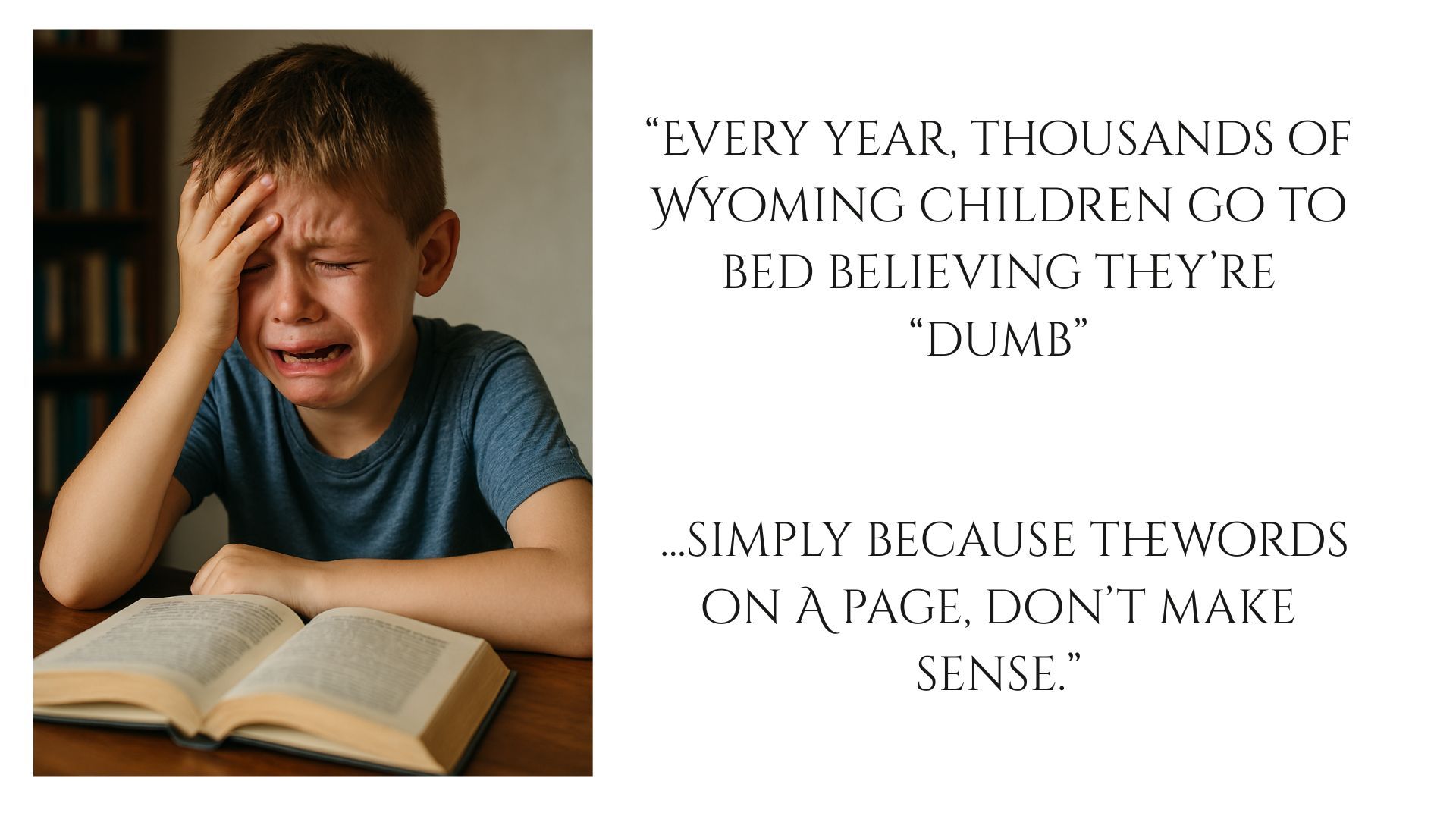
Adolescent students cried while telling lawmakers about their own debilitating reading struggles and the subsequent anxiety and self-doubt they felt. Parents broke down describing the frustrations of watching their children advance in grades even as their reading difficulties undeniably impacted their performance. A grandfather's voice cracked as he recounted the transformation his granddaughter made once she was finally identified as dyslexic and received appropriate help.
"Please do not fail these children," the grandfather, John Ridley, implored lawmakers on the Legislature's Joint Education Committee.
Ridley joined family members, students and educators calling for the committee to advance draft legislation that would create a more robust K-12 language and literacy program in Wyoming.
Over several hours Wednesday, the literacy advocates described in detail their own personal challenges with reading instruction in Wyoming schools. Parents talked about recognizing deep learning challenges in their children that educators assured them were no big deal. Educators spoke about how a popular method for teaching reading has been debunked in recent years and should be outlawed for the way it leaves certain students behind. And students spoke of a growing dread and anxiety around their inability to keep up in school.
Many of them talked about Paul Pine, the Cheyenne fifth grader whose story has become emblematic of how deeply literacy struggles can impact lives. Despite repeating kindergarten and receiving small-group interventions, Pine was only reading at a first-grade level by fifth grade. It wasn't until that year that assessments determined he was likely dyslexic. By then he was distraught, and he died by suicide one day in 2023.

As part of Pinedale High School's literacy lab curriculum, older students read aloud to younger students in the district. (Courtesy)
Ultimately, lawmakers agreed to sponsor the bill as a committee in the 2026 Legislature. Their vote comes just weeks after Superintendent of Public Instruction Megan Degenfelder announced a new statewide language and literacy initiative involving stakeholders such as parents and the University of Wyoming. Together, they represent a commitment to align Wyoming's educational system with top evidence-based methods for building student literacy.
A group effort
The bill aims to ensure that every K-12 Wyoming student develops strong language and literacy skills and that struggling readers do not fall through the cracks.
It comes as reading scores in Wyoming and nationally have ticked down in recent years. In 2024, 36% of the state's fourth graders and 29% of eighth graders performed at or above the proficient level in reading on national standardized NAEP tests, lower than the previous five years.
Some 32% of Wyoming fourth graders performed below basic, which was a slight increase from 29% in 2022. For eighth graders, 30% scored below basic in 2024, up one percentage point from 2022.
Wyoming's scores hovered above the rest of the country; the state has long ranked comparatively high in national testing. But literacy challenges still appear across the educational spectrum.
National experts have pointed to reading instruction as one of the contributing factors. Journalist Emily Hanford's well-known 2022 podcast "Sold a Story" exposed how educators across the country believed they were teaching a best-practice approach to reading that was later disproven. The podcast shifted how the literacy field views reading instruction. At least 26 states have passed laws about how schools teach reading since it began to air.
Wyoming could be next. The legislation resulted largely from the work of a literacy subcommittee with input and feedback from stakeholders working on the statewide initiative.
The statewide partnership includes a range of entities — from the UW College of Education to WYO Right to Read and the Wyoming Professional Teaching Standards Board.
"This was a group of highly educated, highly focused individuals who all came together to reflect their interests, and those interests are reflected in the document," said Sen. Chris Rothfuss, D-Laramie, who worked on the subcommittee. "I honestly think this bill is exceptional at this point."

Pinedale literacy specialist Faith Howard leads a session on filling literacy gaps in high school students during the Wyoming Department of Education’s “Embracing Literacy” conference in June 2025. (Zach Agee/WyoFile)
That includes shoring up statewide assessments to better identify dyslexia and other learning disabilities; ensuring that every district has a written literacy strategy; triggering individualized education services for struggling readers; and mandating that no district relies solely on a debunked approach, known as a "three-cueing system," to teach reading.
"This bill reflects what we've seen in other states that have successfully implemented literacy policy," said Nish Goicolea, chief policy officer at Wyoming Department of Education.
Pinedale teacher Lindsay Adam told lawmakers
"We can dig ourselves out of this hole," Adam said. "But we spent the last 30 years digging our way into it. So it's going to take some time, and it's going to take some money."
'A promise to Paul'
The Education Committee heard several hours of testimony Wednesday related to the bill, including support from parents and concerns about how the measure could have disparate impacts on Wyoming's wide range of districts.
When the committee closed testimony and began to work the bill, Sen. Charles Scott, R-Casper, said he didn't think it was quite "ready for prime time."
"I think it is headed in the right direction," Scott said, but added, "I think it has some major deficiencies and some things that need to be fixed."
Martha Lawley, R-Worland, who also sat on the subcommittee, cautioned against "letting the perfect get in the way of the good." Committee chair and retired teacher Wendy Schuler, a Republican state senator from Uinta County, echoed that, and the measure carried enough votes to advance.
During public testimony, many people talked about how Paul Pine's mother, Chandel, had connected them with one another and to resources crucial for helping them or their students deal with reading difficulties. They have found community in the common goal, they recalled.
Indeed, after she first testified in 2023, Chandel Pine and her husband founded a nonprofit called Paul's Mountain. [text appears incomplete in original]
the nonprofit has connected their families to in the two years since.
It's part of a vow Chandel Pine made in the wake of her son's death. "After that first testimony, I made a promise to Paul, to every child like him, that his story would not end in silence," she told the committee.
Kim Coulter has spent a lot of time and money supplementing her daughter's education due to a reading disability, she told lawmakers. Coulter likened reading gaps to a cracked foundation — a base of all other learning that is fundamentally compromised.
"Having additional support in place when we recognize a cracked foundation can help support future growth in each child's education, allowing our children to be successful learners," Coulter said. "This bill is that support."
Parallel paths
Meantime, the statewide initiative has laid out plans that also aim to bolster literacy support. Those include offering professional development to educators statewide in the "science of reading" — a body of evidence that supports things like phonemic awareness, phonics, fluency and comprehension. Wyoming's educator preparation pathways will be expanded through a new dyslexia specialist program at UW. And a new grant will allow for Wyoming educators to earn national reading instruction certification.
Wyoming Superintendent of Public Instruction Megan Degenfelder speaks at Central Wyoming College in September 2025. CWC Vice President of Academic Affairs Dr. Kathy Wells stands nearby. (Central Wyoming College)
The education department also secured a $24.4 million federal grant this fall to improve literacy instruction. The department will launch a competitive grant process for school districts in January to disperse these funds.
The statewide initiative isn't just a one-time collaboration, Degenfelder said in a statement. "This is an unprecedented coalition of state education leaders and parents united around ensuring that every kid in Wyoming can read at grade level."

Wyoming Superintendent of Public Instruction Megan Degenfelder speaks at Central Wyoming College in September 2025. CWC Vice President of Academic Affairs Dr. Kathy Wells stands nearby. (Central Wyoming College)
The education department also secured a $24.4 million federal grant this fall to improve literacy instruction. The department will launch a competitive grant process for school districts in January to disperse these funds.
The statewide initiative isn't just a one-time collaboration, Degenfelder said in a statement. "This is an unprecedented coalition of state education leaders and parents united around ensuring that every kid in Wyoming can read at grade level."