Literacy advocates aim to educate legislators on science of reading
This article has been written by
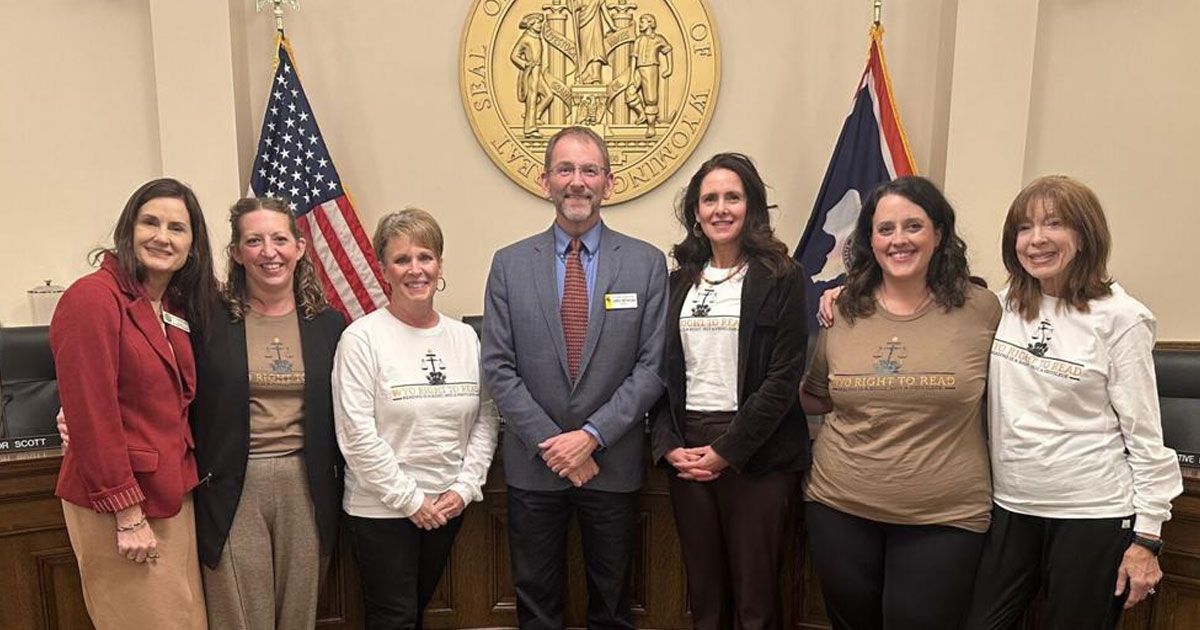
WYO Right to Read advocates pose with state Sen. Chris Rothfuss, D-Laramie. Courtesy of WYO Right to Read
CHEYENNE — Dyslexia advocates pushing for new legislation to address reading intervention in the state may face an uphill battle getting a bill unrelated to the budget passed during the upcoming session.
Though the bill ultimately received support from lawmakers during a Joint Education Committee meeting earlier this month, there is still a lot of advocacy needed to get the bill passed.
If passed, the bill would establish a more robust K-12 language and literacy program.
"The biggest thing is we've just got to make sure that our fellow legislators understand that in their own districts we're leaving kids behind," co-Chair Sen. Wendy Schuler, R-Evanston, told the Wyoming Tribune Eagle.
Not only will advocates face the typical struggles of getting a non-budget bill introduced — which requires a two-thirds majority in a bill's chamber of origin — and passed during a budget session, a handful of legislators have expressed concerns about government overreach and the extent to which the bill governs the way reading is taught.
Wyoming already has literacy-related laws on the books; however, advocates with local nonprofit WYO Right to Read say that those laws are not being enforced, and children are being left behind.
Unlike existing laws, this new bill is focused on more up-to-date methods supported by the science of reading, a comprehensive body of research that explains how the brain learns to read and write.
"Our goal is to go and meet with every legislator," Gay Wilson with WYO Right to Read said. "It's not just us, it's other stakeholders in the state that want to help educate legislators, principals and teachers on evidence-based instruction and the science of reading. Because … they don't know what they don't know."
As it is currently written, the bill would prohibit the use of three queuing systems as a basis for teaching word recognition, and outlines requirements for how all Wyoming students, particularly those with dyslexia or other reading difficulties, would receive "structured, evidence-based literacy instruction," according to WYO Right to Read.
"Every time you turn around, there's a principal, there's this teacher, a special ed teacher and administrators saying, 'Well, I'm sorry, the state of Wyoming doesn't recognize dyslexia,'" Annie McGlothlin with WYO Right to Read said.
Though Wyoming legally does recognize dyslexia, McGlothlin said misinformation in school districts has led to several parents being told that is not the case.
"When that misinformation is being disseminated across our state … what does that say about children's rights to read?" McGlothlin said.
While the state ranks competitively in academic testing, literacy issues are still prevalent, particularly in test scores. In 2024, fewer Wyoming students performed at or above proficiency levels than in the previous five years.
In 2024, NAEP testing showed 36% of the state's fourth graders and 29% of eighth graders performed at or above the proficient level in reading.
Earlier this month, several parents, advocates and children told the committee, sometimes through tears, about the struggles that kids not meeting proficiency standards face.
Chandel Pine, an advocate with WYO Right to Read, was among those parents. Her son, Paul, faced mental health problems that stemmed from reading difficulties, even after being held back in kindergarten and receiving interventions each year. He died by suicide in fifth grade.
"He never got that instruction in school because he was supposed to on the first day of his Individualized Education Plan (IEP) when he hung himself," Pine said.
Pine noted that most parents whose children face reading difficulties aren't aware of the terminology around reading. They don't know what the science of reading is, or how some methods of teaching reading are more evidence-based than others. All she knew when Paul died was that she trusted the public school system to teach her son to read.
"After years of failed interventions that impacted my son's mental health — he thought he was stupid, that he didn't deserve many things, he just beat himself up because he didn't know how to read — why did we have to wait until that point?" Pine said.
For parents like Pine, who are aware of the science of reading and recommended methods, this bill serves as a way to catch the kids who are being left behind.
Rep. Tom Kelly, R-Sheridan, was among those critical of the bill. He noted that while it is clear the state has a problem, he worried about "a sweeping one-size-fits-all policy for all districts," regardless of need.
"I do have concerns that if there are districts that currently have in place systems that are working that this could possibly disrupt those systems that are working," Kelly said during the committee meeting.
Kelly's concerns were shared by Wyoming Association of School Administrators Executive Director Boyd Brown.
"I'm not aware of any other place in statute where a teacher was told they could not use an instructional tool to help improve a student," Brown said, referring to the bill's prohibition of the three queuing system. "... I think teachers need to have as many arrows in their quiver as students need to be successful."
WYO Right to Read advocates rejected the idea that this would disrupt working programs, because those programs don't work for kids with dyslexia. Rather they said that these methods are proven to work for every child, without leaving kids with learning disabilities behind.
"Every child learns to read the same way," Kari Roden with WYO Right to Read said, referring to the science of reading. "For some, it's easier, and for some, it's harder. You just have to give more intense instruction to the kids where it's harder; that's it."
Like many of the women with WYO Right to Read, Roden has been advocating to the Legislature on this topic for years. She is a Wilson Dyslexia Therapist and a CERI-certified Structured Literacy Dyslexia Specialist, who also serves on the International Dyslexia Association Rocky Mountain Branch Board of
Directors.
Though the concern about overreach was well discussed at the meeting, Schuler said the bill has been such a collaborative effort that hopefully this time they got it right to help Wyoming kids.
"We've got to think outside of our own little community and our own school and our own families, and say, 'Are we doing the best we can to make the best laws we can to help everybody,'" Schuler said.
She added that she, like her peers, wants to see every child be successful and happy and to love
Wyoming like she does.
"If it's an overreach, I think it's an overreach for the right reasons," Schuler said.
GullPrint 12/17/25, 10:30 AM Literacy advocates aim to educate legislators on science of reading | News | wyomingnews.com